Energy insights · Middle East
Masdar's 40.2 TWh, CEER's EXOBOT and 95 MWh of Pakistani Factory Storage in One Week
Nishat Mills and DG Khan Cement signed for 45 MWh of storage days after Fauji Cement approved 50 MWh. Plus Masdar's 2025 results, CEER's first EVs and Yiti's financing.
Pakistani heavy industry committed to roughly 95 MWh of battery storage in a single week. That is the thread worth pulling out of five otherwise unrelated announcements between 16 and 24 September — and it is the kind of pattern that only becomes visible when you read the disclosures together.
The rest of the week ranged from a UAE company report to a Saudi car launch and an Omani financing approval. These are not one programme and not a joint package. They sit at genuinely different stages: signed agreements, a retrospective report, a product reveal, a diplomatic meeting and a funding decision.
Nishat Mills and DG Khan Cement sign for 45 MW and 45 MWh
Profit reported on 24 September that Nishat Mills and DG Khan Cement have signed solar-and-storage installation agreements. Combined scope is 45 MW of photovoltaic capacity and 45 MWh of storage, with generation expected in March 2027. The report cites stock-exchange disclosures, which Arcnex has not independently retrieved.
Two days earlier, Fauji Cement's board approved 50 MWh of storage at two of its plants — the item we covered in last week's briefing. Put together, that is around 95 MWh committed by Pakistani industrial groups inside a week.
Worth keeping the stages apart, though: Fauji Cement's was a board approval, and Nishat and DG Khan's were signed agreements. Neither is a commissioned asset. What the cluster does establish is direction — textiles and cement, two of Pakistan's most exposed industrial sectors, reaching for the same answer at the same moment.
Here is what the disclosure does not tell you, and it is the number that matters most. A battery is described by two figures: how much energy it holds, in MWh, and how fast it can deliver that energy, in MW. Only the first was disclosed. A 45 MWh battery that can discharge at 45 MW runs for about an hour; the same 45 MWh discharging at 15 MW runs for three. Those are different assets bought for different jobs — peak shaving versus riding through an evening — and the published figures cannot distinguish them. The US Department of Energy's storage overview sets out the underlying distinction, and we cover the mechanics in how battery energy storage works.
So if you are a Pakistani manufacturer reading these announcements as a signal to act, the question to put to a supplier is not "how many megawatt-hours". It is "at what power, for how long, against which of my loads". Our framework for that conversation is in commercial and industrial solar in Pakistan.
Masdar reports 40.2 TWh generated in 2025
Masdar's report release of 23 September puts 2025 generation at 40.2 TWh, a reported 38% annual increase, alongside a 66.5 GW portfolio spanning multiple development stages. The figures are company-reported and global in scope.
Two numbers sit in that paragraph and they are frequently collapsed into one. GW is a rate; TWh is an accumulated quantity. A gigawatt figure says how fast capacity can deliver electricity at maximum; a terawatt-hour figure says how much was actually delivered over a year.
The trap is specific and common: divide 40.2 TWh by 66.5 GW, and you appear to get a capacity factor. You do not — because the portfolio denominator includes assets under construction and in development that generated nothing at all in 2025. The arithmetic runs, and the answer is meaningless. What a real capacity factor measures, and what it is good for, is in capacity factor explained.
The 38% growth figure is the more interesting one, and it is worth noting that a performance year of 2025 is not the same as the 2026 publication date. Masdar's role in the region's build-out is set out in the UAE's renewable energy strategy.
CEER unveils the EXOBOT sedan and SUV
CEER presented its flagship EXOBOT electric vehicles at a World Premiere on 21 September. The company's launch statement identifies sedan and SUV models and places the reveal inside Saudi Arabia's automotive-industrial programme. In a separate technical announcement, CEER specifies a First Edition with three motors, all-wheel drive, 850 horsepower and 1,000 Nm of torque.
Those are manufacturer figures from a product reveal, not measurements or a delivery confirmation.
The reason a car launch belongs in an energy briefing is that vehicles are load. A domestic EV programme is simultaneously an industrial policy and a demand-side commitment: every vehicle sold is electricity that has to be generated, delivered and — increasingly — charged at hours the grid can absorb. Saudi Arabia is building the generation and the vehicles in parallel, which is a more coherent position than most markets manage. The generation half of that equation is in Saudi Arabia's renewable energy strategy.
Pakistan and the GCC discuss energy cooperation
Radio Pakistan reported on 24 September that Ishaq Dar and GCC Secretary General Jasem Mohamed Al Budaiwi discussed energy alongside trade, investment and security in New York.
No project value, contract or implementation timetable was announced. What happened is a diplomatic discussion about cooperation — a real event, and a long way short of an executed investment. We label the stage deliberately because the gap between a meeting and a signed deal is where most energy reporting goes wrong.
The OPEC Fund approves US$40 million for Yiti's Plaza District
On 16 September the OPEC Fund announced up to US$40 million toward construction of the Plaza District at Yiti Sustainable City in Oman. We carry it as regional watch, with its original date, rather than as news broken today.
The IFC's environmental and social disclosure fills in the scale: 17 buildings, 1,225 apartments, roughly 13,400 square metres of offices and 14,600 square metres of commercial space. It names Sustainable Development Investment Company as the project company, a joint venture between OMRAN and SEE Holding.
The energy content is in the shared infrastructure. The wider development includes solar generation, desalination, wastewater treatment and district cooling — which makes Yiti a district-energy project as much as a real-estate one. In Gulf conditions, centralised cooling is usually the single largest determinant of a development's electricity demand, a point we set out in district cooling in the Gulf; the water side is covered in solar-powered desalination.
Two cautions. The 2040 net-zero date is a target, not an achievement. And the OPEC Fund allocation and the IFC disclosure are separate financing records describing different scopes — combining their figures into one total, or reading them as evidence that every facility is built, would be wrong.
A note on sourcing
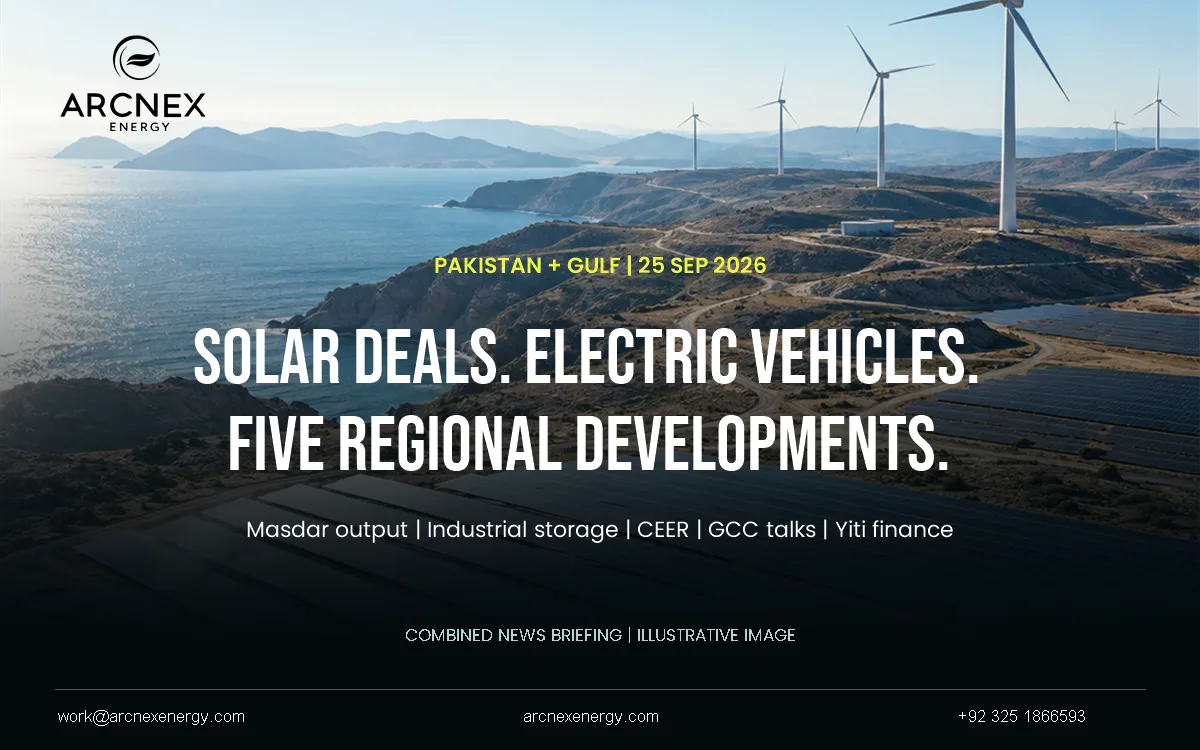
This briefing draws on company releases, an official broadcaster, a development-finance institution and an IFC project disclosure. The Pakistan industrial item relies on Profit's account of exchange filings, which we have not independently retrieved. Specifications and results remain attributed to their issuers throughout; planned dates remain expectations and targets remain targets. The accompanying image is an original illustration and does not depict any named facility, vehicle or development.
Read the region with the stage attached
Arcnex reports what an announcement establishes and what it does not — with the date, the source and the stage in view, and no paywall in between.
- Follow our Middle East energy coverage for Gulf procurement, industry and policy.
- Read our Pakistan coverage for the industrial and grid story behind these deals.
- Explore the battery storage desk for the technology underneath the week's biggest theme.
- Subscribe to The Energy Edit — free, independent reporting, start here.
Building, buying or supplying across these markets? Explore partnership with Arcnex Energy or contact the team at work@arcnexenergy.com.
ANSWERS
Questions answered in this story
How much solar and storage did Nishat Mills and DG Khan Cement sign for?
A combined 45 MW of photovoltaic capacity and 45 MWh of battery storage, with generation expected in March 2027. Profit reported the agreements on 24 September 2026, citing stock-exchange disclosures. The battery's power rating was not disclosed, so the storage duration cannot be derived from the figures given.
How much electricity did Masdar generate in 2025?
40.2 TWh, which Masdar reports as a 38% increase year on year, in a sustainability report released on 23 September 2026. The company also cites a 66.5 GW portfolio, but that portfolio spans multiple development stages and is a different measure from electricity actually generated.
What is the difference between a GW portfolio and TWh generated?
GW is a power rating — the maximum rate at which capacity can deliver electricity. TWh is an accumulated quantity of energy over a period. A portfolio figure can include assets under construction or in development that generated nothing, so dividing a portfolio's GW into a year's TWh does not produce a meaningful capacity factor.
What is the CEER EXOBOT?
CEER's flagship electric vehicle line, unveiled at a World Premiere on 21 September 2026 in sedan and SUV forms. The manufacturer specifies a First Edition with three motors, all-wheel drive, 850 horsepower and 1,000 Nm of torque. A product reveal is not confirmation of customer deliveries, and no delivery volume or availability outside the announced market has been stated.
What is Yiti Sustainable City's Plaza District?
A district within Oman's Yiti development. IFC disclosure describes 17 buildings with 1,225 apartments, approximately 13,400 square metres of offices and approximately 14,600 square metres of commercial space, inside a wider development with shared solar generation, desalination, wastewater treatment and district cooling. The OPEC Fund approved up to US$40 million toward its construction on 16 September 2026.