Policy & markets · Middle East
Oman Port Plans Pair Solar, Batteries and Shore Power
Oman's transport ministry set out green-mobility development plans including solar, batteries and shore power. Why ports are an unusual energy customer, and what this stage establishes.
Regional watch · 2026-09-03 · Development plans. Oman's transport ministry outlined development plans including solar, batteries and shore power in its 3 September green-mobility update. Read the source — Oman MTCIT.
Arcnex reports this as a planning signal. What follows is our editorial reading of why ports are a genuinely interesting energy customer, and what this stage does and does not establish.
A port is an electricity problem before it is a transport one
Ports are usually discussed as logistics infrastructure. From a grid perspective they are something more specific: a concentrated industrial load with an unusually difficult shape.
Three things drive that:
- Shore power. A berthed ship that shuts down its auxiliary engines has to draw that energy from somewhere. Large vessels represent substantial connected load, arriving and departing on a schedule that is only partly predictable.
- Electrified handling equipment. Cranes, straddle carriers and yard vehicles draw heavily and intermittently, with sharp peaks as loads are lifted.
- Cold storage and logistics buildings. A steadier baseline running continuously.
The result is a site whose peak demand can sit far above its average. That matters commercially, because grid connections are sized and charged against peaks rather than averages.
Which is why storage, not just solar, appears in the list
This is the part of the announcement worth noticing.
Solar on warehouse and terminal roofs is straightforward and well matched to daytime operations. But solar does nothing about a demand spike at 2am when a vessel connects to shore power.
Batteries do. Storage lets a port serve short, severe peaks from stored energy rather than from a connection sized to handle them — the same peak-shaving logic that makes storage attractive to industrial users generally, and which we cover on the battery storage desk.
So a list containing solar, batteries and shore power is at least internally coherent. Each element addresses a different part of the same problem. Whether these particular elements are designed to work together as one system, or are separate initiatives grouped into one announcement, is exactly what the source does not establish.
What the development plans stage means
An announcement at this stage tells a reader that intent and, usually, budget exist. It does not tell them:
- Which specific facilities are covered.
- Who owns and who operates each element.
- What has reached contract, construction or commissioning.
- Which dependencies — grid reinforcement, vessel-side equipment, tariff arrangements — remain unresolved.
Shore power has a particular dependency worth flagging: it only delivers value if visiting ships are equipped to use it. Shoreside infrastructure without compatible vessels is a stranded asset, so adoption depends on the fleets actually calling at the port.
Where this fits in Oman's wider energy strategy
Oman has been deliberate about structuring its energy transition, particularly in how it allocates development rights — the approach we examine in Oman's green hydrogen strategy. Ports sit naturally alongside that: they are both large energy consumers and the export gateway for energy products.
That makes port electrification strategically consistent rather than incidental. It also means progress should be measurable in the same way — by documents and milestones, not by programme headlines.
This item is one of five in our 14 September regional watch. The full briefing is in Solar & Storage: Middle East and South Asia Watch.
Follow Gulf infrastructure with the stage attached
Arcnex labels the stage of every announcement so a plan is never mistaken for an operating asset.
- Read our Middle East energy coverage for projects, procurement and policy.
- Explore the policy and markets desk for the structures behind them.
- Subscribe to The Energy Edit — free, independent reporting. Start here.
Working on port electrification or industrial storage? Explore partnership with Arcnex Energy.
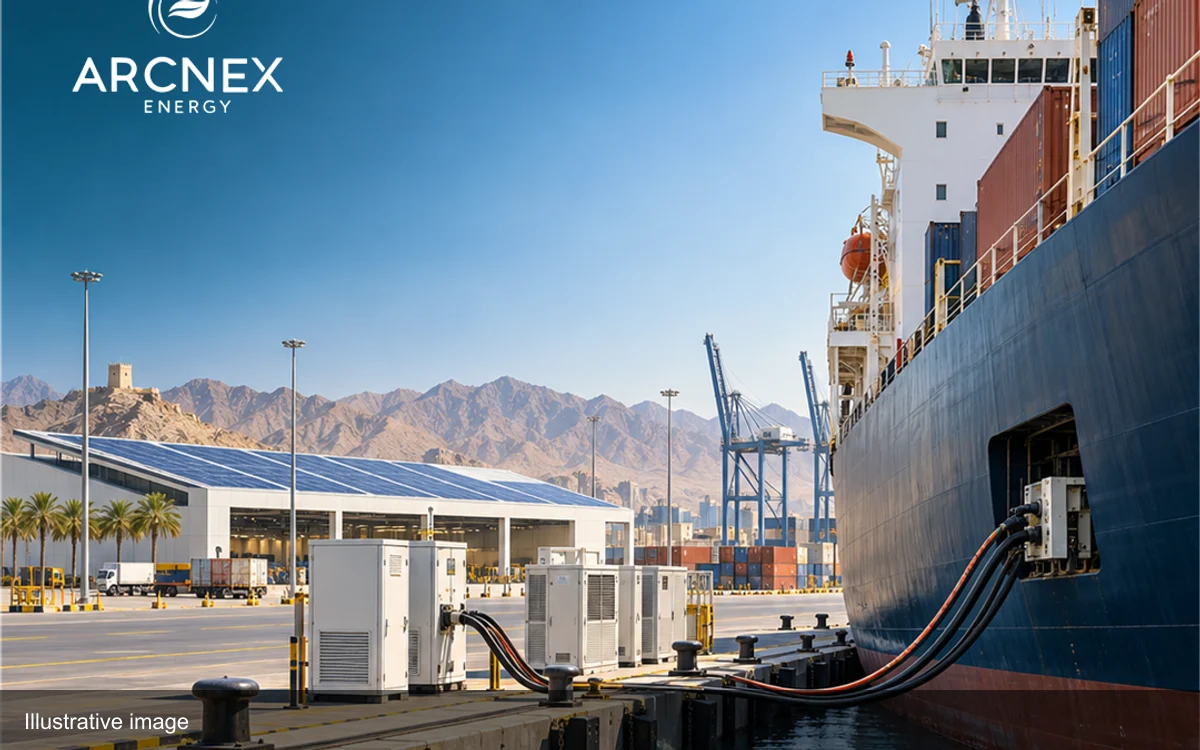
*The image accompanying this article is an original illustration and does not depict a named Omani port.*
ANSWERS
Questions answered in this story
What is shore power at a port?
Shore power, sometimes called cold ironing, lets a berthed ship shut down its auxiliary engines and draw electricity from the shore instead. It removes engine emissions at the quayside and shifts that energy demand onto the grid.
Why would a port need battery storage?
Because shore power connections and electric handling equipment create large, short and unpredictable demand peaks. Storage can absorb those peaks so the port does not have to size its grid connection for the worst moment.
Does this announcement mean Omani ports now run on solar?
No. Arcnex reports this at the development plans stage. The update describes intended systems, not commissioned and operating infrastructure.
What would the next meaningful update look like?
A specific facility with a defined scope, identified owner and operator, and a dated construction or commissioning milestone — rather than a repeat of the same programme headline.