Policy & markets · Pakistan
Pakistan Minister Backs Solar and Storage to Cut Peak-Hour Costs
Radio Pakistan reported on 3 September that the power minister supports solar and battery storage to reduce peak-hour costs. What a policy statement does and does not establish.
Regional watch · 2026-09-03 · Policy statement. Radio Pakistan reported on 3 September that the power minister supports solar and battery storage to reduce reliance on expensive peak-hour electricity. Read the source — Radio Pakistan.
That is the whole verified fact. What follows is Arcnex's editorial reading of where it sits, and what would have to happen next for it to reach a household or business bill.
Where a statement sits on the evidence ladder
Energy announcements arrive at very different stages, and conflating them is the most common error in reading this sector.
- A statement of support signals political direction.
- A notified scheme creates eligibility, budget and an application process.
- A regulatory determination changes a tariff, a rate or a settlement rule.
- A procurement document commits money to a specific quantity of capacity.
This item is the first of those. It tells you which way policy is leaning. It does not, on its own, change what you pay, what you can claim, or what your distribution company will approve.
That distinction matters more in Pakistan than in most markets, because the variables that actually govern rooftop economics — the net metering buyback rate, the settlement mechanism, the applicable tariff slab — are all set through determinations rather than speeches. We set out how those mechanics work in net metering in Pakistan.
Why peak-hour cost is the right target
The minister's framing is worth examining on its merits, because the diagnosis is sound even though the statement is not a measure.
Pakistan's expensive hours are a structural problem, not a seasonal one. Peak demand persists into the evening, which is precisely when solar generation has stopped. Serving it requires thermal generation or storage, and the capacity obligations attached to that generation feed directly into the cost stack every consumer pays — the mechanism we explain in Pakistan's circular debt.
So pairing solar with storage does address the actual constraint. Solar alone shifts nothing into the evening; solar plus storage does. Whether that pairing is economic for any individual consumer is a separate question with a different answer for each site, which is why we treat solar batteries as a continuity purchase rather than a savings purchase.
What a buyer should do with this
Very little, immediately — and that is the honest answer.
A policy statement is not a reason to accelerate or delay a purchase. The decision still rests on your own numbers: your effective tariff, the share of your consumption that falls in daylight, your roof, and your sanctioned load. We walk through that calculation in is solar worth it in Pakistan.
What it does justify is scepticism toward any vendor who cites this statement as evidence of a coming subsidy, a guaranteed rate or a limited-time opportunity. No such thing has been established. If a quotation's business case depends on a policy change that has not been notified, that is a risk the buyer is being asked to carry.
The next evidence point
A statement becomes a story when it produces a document. The things worth watching:
- A notified scheme with eligibility criteria and a budget.
- A NEPRA determination altering net metering terms or tariffs.
- A procurement notice for storage capacity with a defined quantity.
- A financing facility with published terms.
Any of those would be a material change. A restatement of the same position would not.
This item is one of five in our 14 September regional watch. The full briefing, with all five sources and the stage of each, is in Solar & Storage: Middle East and South Asia Watch.
Follow Pakistan's power sector with the documents attached
Arcnex reports the stage of every announcement, so readers can tell a direction of travel from a decision.
- Follow our continuing Pakistan energy coverage for determinations as they land.
- Read the policy and markets desk for the reform picture behind them.
- Subscribe to The Energy Edit — independent reporting, free and no paywall. Start here.
Working in Pakistan's solar and storage market? Explore partnership with Arcnex Energy.
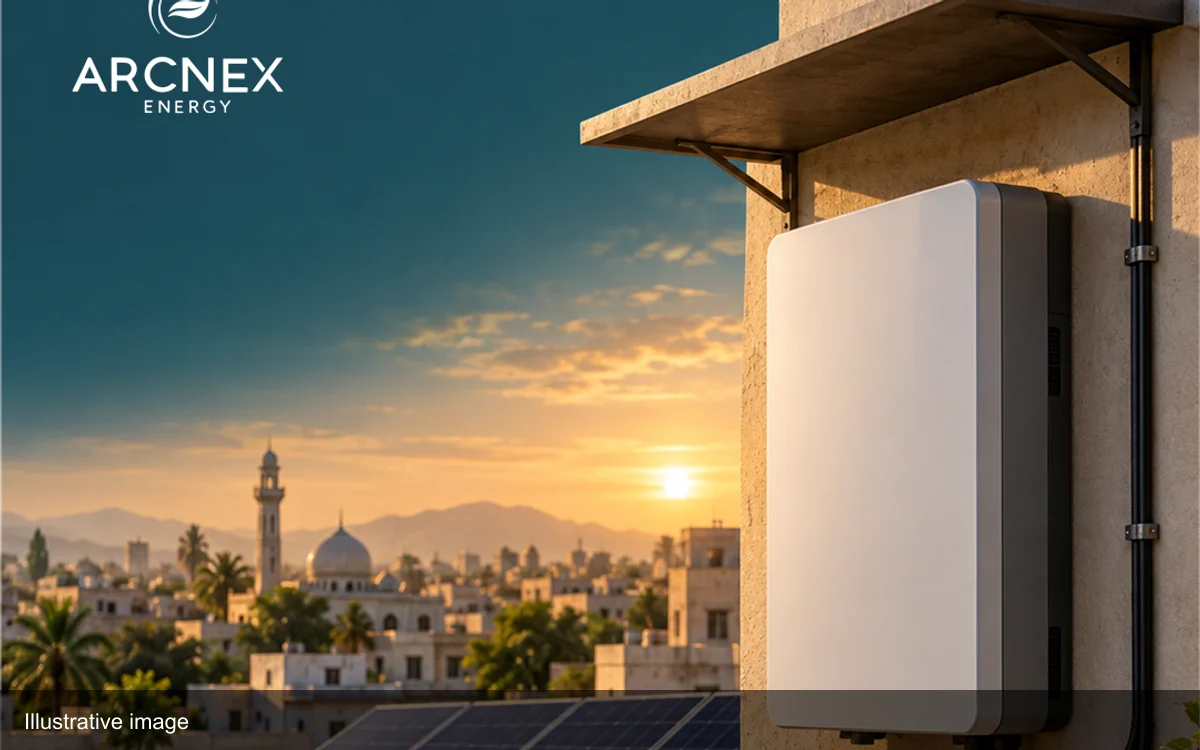
*The image accompanying this article is an original illustration, not a photograph of a documented installation.*
ANSWERS
Questions answered in this story
What exactly did the Pakistani power minister say?
Radio Pakistan reported on 3 September 2026 that the minister supports promoting solar energy and battery storage to reduce dependence on expensive peak-hour electricity. Arcnex reports this as a policy statement rather than an enacted measure.
Does this mean new solar subsidies in Pakistan?
No. A statement of support does not create a subsidy, change an eligibility rule or alter a tariff. Any such change would arrive through a notified scheme or a regulatory determination, which is the document to look for.
Should I wait for policy before installing solar?
Waiting has its own cost, because you continue buying grid electricity meanwhile. The stronger approach is to size a system around your own daytime consumption so the investment does not depend on a policy change that may not come.
Where can I read the original report?
The source is Radio Pakistan's 3 September 2026 report, linked in the article below. Arcnex publishes the source and date so readers can check the original wording themselves.