
Policy & markets · South Asia
Bangladesh Reiterates Its 20% Renewable Electricity Target for 2030
A 9 September parliamentary response reiterated Bangladesh's 20% renewable electricity target for 2030. Why land scarcity makes this a rooftop question rather than a solar farm one.
Regional watch · 2026-09-09 · Target reiterated. The Business Standard reported a 9 September parliamentary response reiterating Bangladesh's 20% renewable electricity target for 2030. Read the source — The Business Standard.
Arcnex reports this at the target reiterated stage. What follows is editorial context on why the constraint behind this target is unusual, and what would constitute evidence of progress toward it.
A target is an endpoint, not a position
The distinction is worth stating plainly because it is so often blurred.
A target describes an intended outcome at a future date. It is not the share already achieved, and it is not a pipeline of financed projects. Restating a target confirms that it remains government policy — genuinely useful information — while establishing nothing about the distance already travelled.
The reporting that carries information is the sequence between statement and endpoint: which projects enter procurement, which secure documented financing, which report construction, which reach operation. A dated sequence of those changes lets a reader assess progress. A restated percentage does not.
Why Bangladesh's constraint is unusual
Most countries pursuing renewable targets are limited by cost, grid capacity or policy. Bangladesh's binding constraint is more fundamental: land.
Bangladesh is among the most densely populated countries in the world, and its land is among the most agriculturally productive. A utility-scale solar plant needs a large contiguous area. In Bangladesh, that area is almost certainly growing food and supporting livelihoods.
This produces an acute version of a trade-off many countries face — and it is the opposite endowment to the Gulf, where flat desert with no competing use is allocated to projects cheaply, one of the reasons Gulf solar is so inexpensive.
The sunshine in Bangladesh is adequate. The land is not available. Any credible pathway to 20% has to account for that, which is why we treat this as a rooftop question in our fuller analysis of Bangladesh's energy transition.
Which makes this a rooftop target
If ground-mounted solar is constrained, the capacity has to come from somewhere else. The strongest candidate is industrial and commercial rooftops, and the garment sector in particular.
The logic holds on every dimension:
- Roof area already exists, requiring no land acquisition and displacing nobody.
- Consumption is daytime-heavy, so most generation is self-consumed at full value rather than exported — the variable that decides project returns, as we set out for commercial and industrial solar.
- International buyers increasingly require supply chain emissions reductions, giving factories a commercial reason beyond the electricity bill.
- Grid reliability concerns add value to on-site generation.
The barriers are financing structures, net metering implementation, roof structural capacity on older buildings, and split incentives where factories are leased rather than owned. Those are solvable problems, and they are different problems from the ones a solar farm faces.
Floating solar on Bangladesh's substantial water bodies is the other route that sidesteps the land conflict, at higher cost and with monsoon engineering demands.
What progress would look like
Concrete, datable evidence rather than restated ambition:
- Rooftop capacity additions reported with dates and locations.
- Net metering rules that industrial consumers can actually use.
- Financing facilities with published terms and drawdown.
- Procurement rounds that clear, with named winners.
- Installed capacity figures against the trajectory the target implies.
Any of those would justify a follow-up. A further reiteration would not.
This item is one of five in our 14 September regional watch. The full briefing, with each item's stage and source, is in Solar & Storage: Middle East and South Asia Watch.
Follow South Asia's transition by the evidence
Targets are announced often. Arcnex reports what changes between them.
- Read our South Asia energy coverage for policy and project developments.
- Explore the policy and markets desk for structural analysis.
- Subscribe to The Energy Edit — free, independent reporting. Start here.
Working on industrial rooftop solar or energy finance in Bangladesh? Explore partnership with Arcnex Energy.
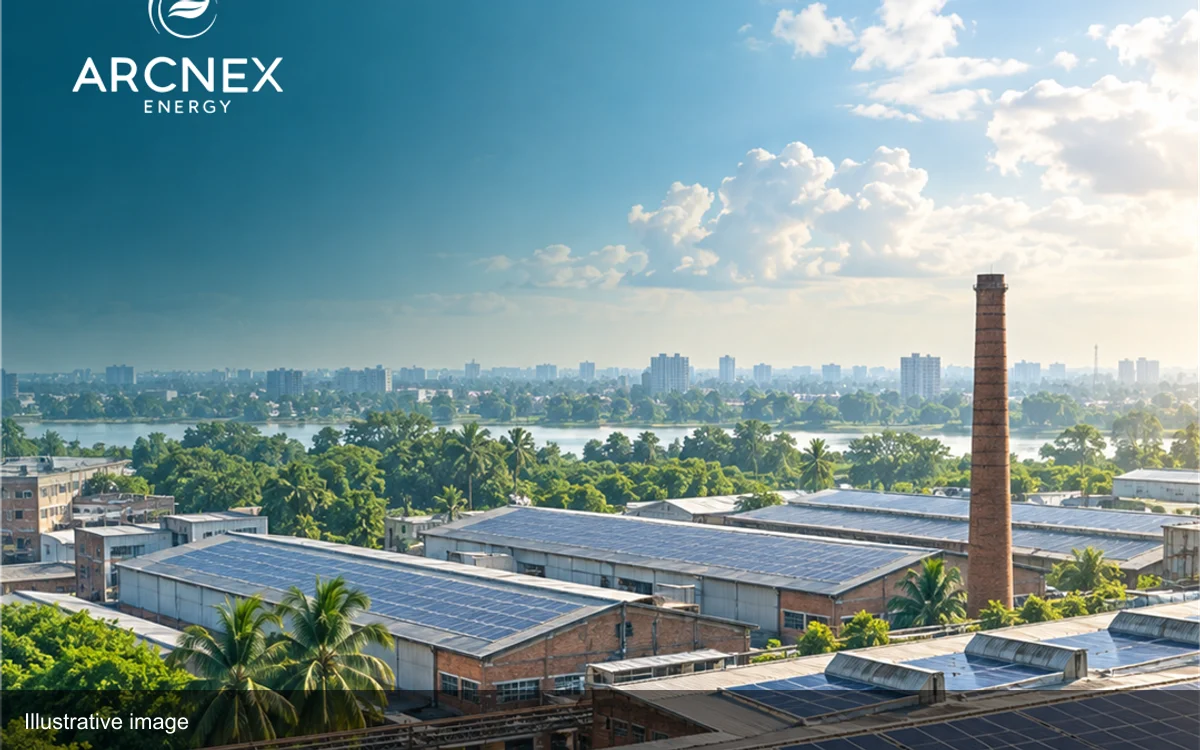
*The image accompanying this article is an original illustration, not a photograph of a commissioned project.*
ANSWERS
Questions answered in this story
What is Bangladesh's renewable energy target?
A 9 September 2026 parliamentary response reiterated a target of 20% renewable electricity by 2030, as reported by The Business Standard. Arcnex reports this as a reiterated target rather than a new announcement.
Does a reiterated target mean progress?
Not by itself. Restating a target confirms it remains policy. Progress is evidenced by projects entering procurement, reaching financial close and beginning construction or operation.
Why is large-scale solar difficult in Bangladesh?
Because Bangladesh is among the most densely populated countries in the world and its land is highly productive agriculturally, so ground-mounted solar competes directly with food production and affects many households.
Where is the most realistic opportunity?
Industrial and commercial rooftops, especially in the garment sector, which combine large existing roof areas with high daytime consumption and export-market pressure to reduce supply chain emissions.