Battery storage · South Asia
NTPC Invites Sodium-Ion Battery Pilot Proposals, Closing 15 October
NTPC's tender portal lists a sodium-ion battery storage pilot expression of interest closing 15 October 2026. Why a utility pilots this chemistry, and what an EOI establishes.
Regional watch · 2026-09-09 · Pilot solicitation. NTPC's tender portal lists a sodium-ion battery storage pilot expression of interest, with a closing date of 15 October 2026. Read the source — NTPC tender portal. A supporting report indicates the pilot is being pursued with the Global Energy Alliance for People and Planet.
Arcnex reports this at the pilot solicitation stage. What follows is editorial context on why this chemistry is being tested and what a demonstration can and cannot settle.
Why sodium-ion, and why now
Sodium sits directly below lithium in the periodic table and behaves similarly in a battery cell. Ions shuttle between two electrodes through an electrolyte; the operating principle is the same.
The difference that matters commercially is abundance. Lithium is not geologically rare, but economically extractable deposits and processing capacity are concentrated in relatively few countries. Sodium is available essentially everywhere, including from seawater.
For a large utility in a country pursuing supply chain diversification, that is a strategic argument independent of price. A storage technology whose inputs cannot be constrained by another country's export policy has value that a cost comparison alone does not capture — a consideration we examine in South Asian solar manufacturing.
The trade-off is energy density. Sodium ions are larger and heavier, so cells store less per kilogram. For an electric vehicle that is limiting. For a container on a concrete pad it is close to irrelevant — the same asymmetry that made lithium iron phosphate, rather than higher-density chemistries, the default for grid storage. We set out that comparison in LFP vs NMC and the sodium-ion case in sodium-ion batteries explained.
What a pilot is for
A demonstration exists to convert claims into measurements under defined conditions. The questions a well-designed pilot answers:
- How does the technology perform under a specified duty cycle, not a laboratory profile?
- How does it behave at Indian ambient temperatures, across a full seasonal range?
- What degradation occurs over the test period, and how does it compare with the supplier's model?
- How does it integrate with existing grid protection and control systems?
- What operations and maintenance burden does it impose in practice?
Equally important is what a pilot leaves open. A demonstration sized at pilot scale does not establish manufacturing capacity, supply chain readiness, long-term degradation across a twenty-year asset life, or delivered cost at gigawatt-hour volumes.
A responsible conclusion from a successful pilot describes the demonstrated result and its boundary. That discipline is the difference between evidence and publicity.
Why the stage label matters here especially
Sodium-ion attracts enthusiastic coverage, and the gap between a solicitation and a proven technology is where most of that coverage goes wrong.
This item establishes that India's largest utility is seeking proposals. It does not establish that sodium-ion works at grid scale, that it is cheaper than lithium iron phosphate in delivered terms, or that any deployment will follow.
Those would be separate findings requiring separate evidence. Moving directly from an EOI to a claim of technological success skips the part of the story that carries the information.
The context for why India is procuring storage at all — the shift from raw renewable energy toward firm, dispatchable supply — is covered in India's renewable energy targets.
The evidence worth waiting for
- Selection of participants, and on what criteria.
- Installation and commissioning of the pilot system.
- A defined test period with stated operating conditions.
- Published results, including measurements that disappointed.
- Any decision to proceed to a larger deployment, with reasoning.
The last of those is the real signal. A utility that pilots a technology and then declines to scale it has produced useful evidence too.
This item is one of five in our 14 September regional watch. The full briefing is in Solar & Storage: Middle East and South Asia Watch.
Follow storage technology with the evidence attached
Chemistry claims are easy to make and slow to verify. Arcnex reports the stage.
- Read the battery storage desk for technology and procurement analysis.
- Explore our South Asia coverage for regional developments.
- Subscribe to The Energy Edit — free, independent reporting. Start here.
Cell developers and storage integrators: explore partnership with Arcnex Energy.
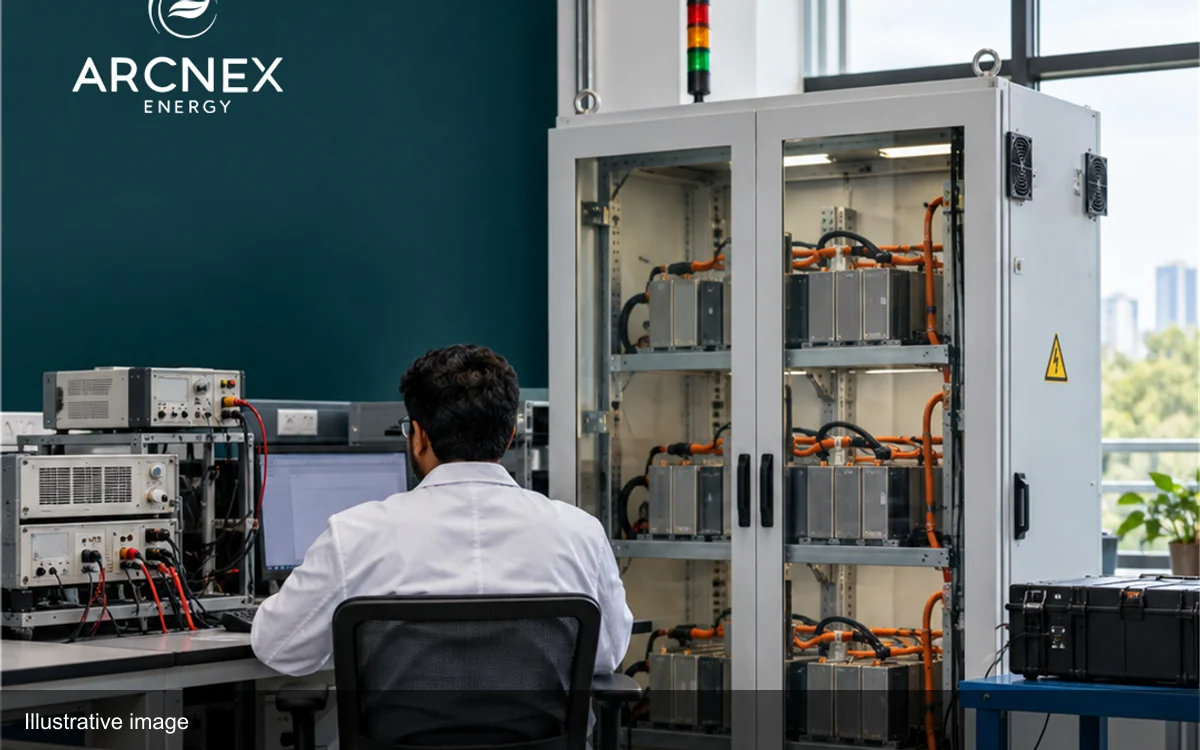
*The image accompanying this article is an original illustration, not a photograph of an NTPC pilot or a sodium-ion product.*
ANSWERS
Questions answered in this story
What has NTPC actually done?
NTPC's tender portal lists an expression of interest for a grid-connected sodium-ion battery storage pilot, with a closing date of 15 October 2026. An accompanying report indicates the pilot is being pursued with the Global Energy Alliance for People and Planet.
What is an expression of interest?
An EOI invites parties to propose or register interest in participating. It opens a process and gathers candidates. It does not award a contract, select a technology or establish that anything has been built or tested.
Why is a utility interested in sodium-ion rather than lithium?
Because stationary storage does not need lithium's energy density, while sodium's abundance reduces supply chain exposure. The trade-off is lower density and less manufacturing maturity, which is precisely what a pilot is meant to test.
When would this pilot produce useful evidence?
Only after selection, installation and a defined test period. The valuable reporting moment is the published result, including what the demonstration did not test.