
Energy insights · South Asia
Bangladesh’s Godda reconnection: why one restored unit is not a complete reliability verdict
A dated Godda reconnection report illustrates why power-system coverage needs clear timestamps, output evidence and a distinction between units and the whole grid.
The milestone is useful when its scope stays visible
The Business Standard reported that Godda Unit 2 synchronised with Bangladesh’s grid on 13 September, citing a Bangladesh Power Development Board official. The report identifies a return-to-grid milestone after a technical problem. It concerns coal-fired generation, not an addition of renewable capacity. Read the report.
The news has a clear relevance to the regional electricity discussion. A generating unit’s status can change while the broader supply situation remains complicated. The responsible reading is to identify exactly what the update establishes before drawing a system-wide conclusion.
This article uses the dated report to explain how to read reliability headlines. It is not a live grid-status bulletin. Readers making operational decisions need current information from the relevant operator or service provider rather than assuming a past news report describes conditions now. The renewable programme this coal unit is not part of is covered in Bangladesh’s renewable energy transition.
Separate a unit from the electricity system
A unit-level statement describes one asset or part of a plant. A system-level statement describes a wider set of conditions. Moving from the first to the second requires additional evidence. The existence of a positive plant update does not supply that evidence by itself.
A useful follow-up would therefore state what changed at the unit and what is known about the wider system at the same time. If the report does not contain that information, its headline should remain at the narrower level.
This is a general reporting discipline, not a judgement about the value of the restored unit. A meaningful contribution can still be described accurately without presenting it as a complete solution. The reader gains more from a precise statement than from a larger claim that the source cannot support.
A timestamp belongs beside the number
Power output is an observation at a time or over a defined interval. If a report provides a figure, the reader should be able to identify when it applied. A later article should not silently present the earlier observation as a current reading.
Ask whether the number is a rating, a scheduled amount, an expectation or measured output. Each can be useful, but each answers a different question. A plant’s nameplate rating is not automatically the amount available to a particular customer at every moment. The gap between a nameplate rating and actual output is exactly what capacity factor measures.
The same care applies to units. MW expresses power; MWh expresses an amount of energy. Avoid phrases that turn a power figure into an ambiguous “MW per hour” claim. A clear unit label is a small editorial choice with a large effect on whether the reader understands the story.
Corroboration helps, but it has a boundary
Daily Sun’s 14 September coverage also described the Godda unit’s return and noted problems elsewhere in supply. That provides corroborating journalism, not an independently audited operational record for this article. Read the corroborating report.
Readers should ask whether two publications obtained separate evidence or are repeating the same statement. Agreement between headlines can be useful, but it should not automatically be described as two independent measurements.
For this pack, the appropriate language remains attributed: the development was reported, and the source identifies an official. We have not obtained the complete original operating logs. Stating that limit keeps the article useful while avoiding a level of verification it does not possess.
What a business reader should ask instead
A business owner often has a narrower concern than the national headline: what service is available at the actual site? The right questions concern the business’s operating hours, essential equipment and the information its supplier can provide.
A past plant-reconnection report cannot answer those questions for every business. Use it as context, then seek the current information relevant to the site. If a provider makes a continuity claim, ask what the claim covers and what conditions apply.
This article does not recommend a particular backup arrangement. It suggests defining the required service before evaluating an option. A supplier’s answer becomes easier to assess when the buyer specifies the task rather than asking for a generic promise of reliability.
An illustrative operating brief
Imagine a small workshop that wants to keep a limited set of activities available during a defined working period. Its manager lists the equipment involved and separates essential tasks from tasks that can wait. The manager records which information is known and asks a qualified provider what additional assessment is needed.
The resulting brief is more useful than a request based only on a national power headline. It gives the provider a clear service to discuss. It also makes exclusions visible: the manager can see if an offer addresses only part of the requirement.
This hypothetical example does not imply that every site has the same constraints or that one technology is the right answer. Its purpose is to connect reliability language with an actual task. That connection matters across conventional generation, renewable systems and storage proposals.
Why this matters to renewable-energy professionals
Renewable-energy coverage also relies on milestone language. A project can be announced, installed, tested or operating; those are different claims. The discipline used in this grid story transfers to reading a solar, wind or storage update without treating those technologies as identical.
When a new asset is discussed, ask what service the evidence establishes. Is the article about a plan, a measured result or an operating arrangement? Is the conclusion limited to the asset, or does it imply a wider system effect? If the latter, what supports the additional claim? We applied the same test to Dhaka’s generation target in Bangladesh reiterates its 20 percent renewable target.
For industry leaders, the benefit is a more useful conversation. Accurate boundaries make it possible to discuss a development’s importance without exaggerating its current role. They also identify what information a future follow-up should add.
A better follow-up headline has a measurable change
The next useful update would provide a current, attributable observation and explain how it differs from the earlier report. It should preserve the distinction between the individual unit, the wider system and the customer’s service.
If no material update is available, the older story should not be repeatedly presented as new. It can still support an explainer like this one, with the original date visible and the purpose stated.
Godda’s reported reconnection is therefore both a regional development and a useful reading lesson. Identify the asset, identify the time and identify the limit of the evidence. That approach makes electricity news more informative for the people who must make decisions from it.
Read electricity headlines with the boundary attached
Arcnex reports what a milestone establishes and what it does not, with the date and the source in view.
- Follow our South Asia energy coverage for grids, generation and policy.
- Explore the energy insights desk for how to read the evidence.
- Subscribe to The Energy Edit — free, independent reporting. Start here.
Working on reliability or backup for a South Asian site? Explore partnership with Arcnex Energy.
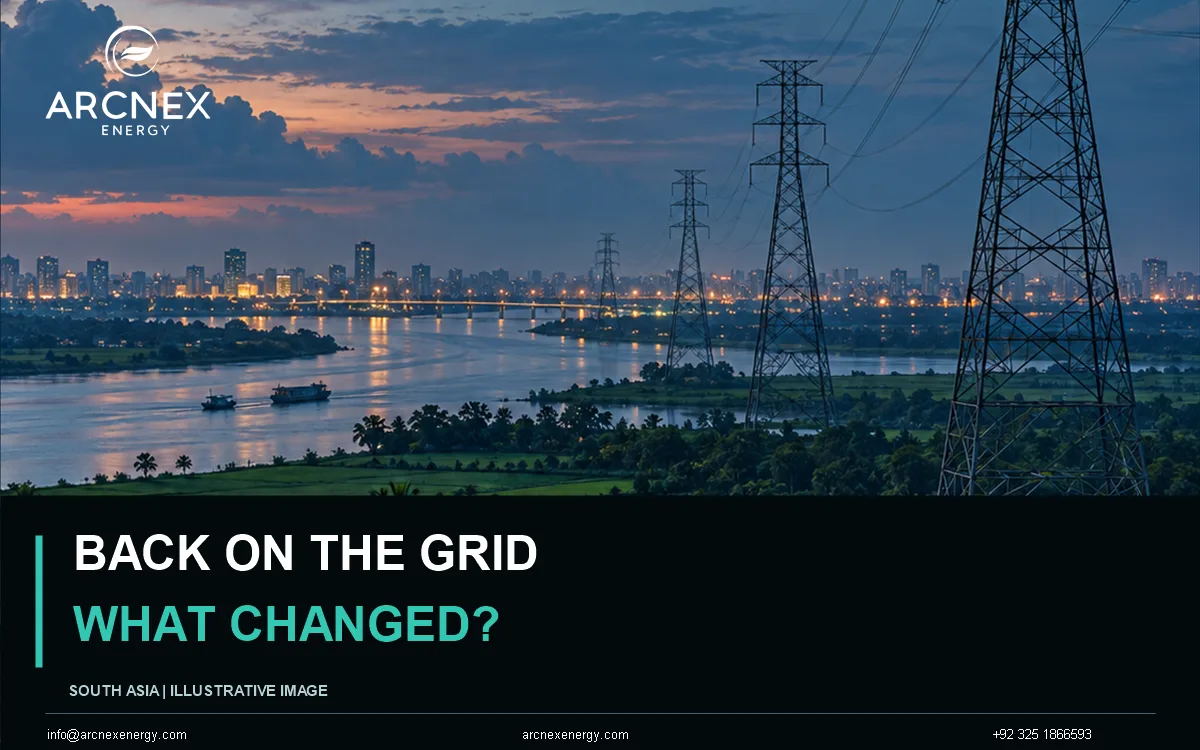
*The image accompanying this article is an original illustration and does not depict a named line or plant.*
ANSWERS
Questions answered in this story
What was the reported development?
The Business Standard reported that Godda Unit 2 synchronised with Bangladesh’s grid on 13 September, citing a BPDB official.
Is Godda renewable generation?
No. The cited report concerns a coal-fired generating unit.
Does synchronisation mean every supply problem is resolved?
No. It is a unit-level milestone; broader conclusions require evidence about the system and customer service.
Why should a power figure include a time?
Output can change. A timestamp shows which observation the figure describes.
Why is the story labelled regional watch?
The 13 September report falls outside the initial 48-hour cutoff used for this resumed pack and is not presented as breaking news.